
Intestinal helminths (parasitic worms) are a relatively infrequent problem in ornamental populations of fish but clinical cases do occur. There are a number of intestinal helminths of interest to ornamental fish; nematodes (roundworms), cestodes (tapeworms) and trematodes (flukes). This article will focus on species belonging to the nematode phyla, Nematoda, as clinical cases of this phyla tend to be more prevalent within hobbyist set ups.
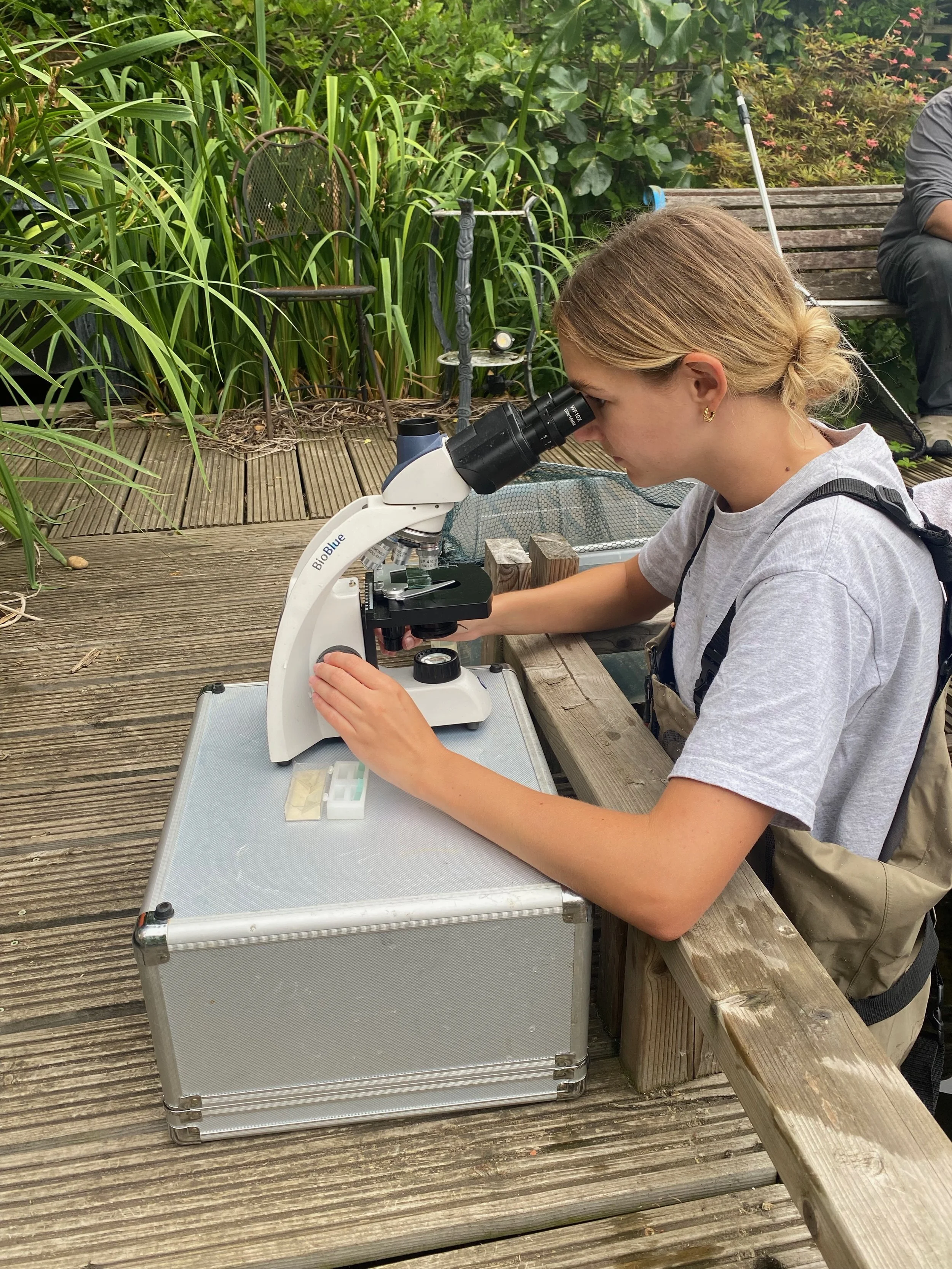
Pond side consultation and diagnosis with Dr Bryony Chetwynd-Glover
There are an estimated 25,000 species of nematode, which as the colloquial name ‘round worm’ suggests, are round and three dimensional in shape, unlike cestodes and trematodes which are dorsoventrally compressed like a piece of paper. They range in size from microscopic to meters in length, like some of the species found parasitizing the digestive tract of oceanic whales. Unlike cestodes and trematodes, nematodes have separate sexes and most are oviparous (produce eggs).
Parasitic nematodes can affect both marine and freshwater species of fish but clinical cases are more prevalent in freshwater species. Clinical signs of helminthiasis can include weight loss, poor growth rates, abnormal faeces and lethargy. Conversely, some fish may show no outward clinical signs with some infections being picked up incidentally at post mortem.
Adult helminths are usually found within the gastrointestinal tract of fish but some larval stages can migrate out from the digestive tract and encyst themselves on viscera or muscle where they lie dormant waiting to be ingested by the next host. Nodules containing encysted larvae can sometimes be seen externally protruding from the skin surface.
Whilst in the digestive tract, adult nematodes attach themselves to the epithelium using specialised mouth parts. Localised damage and inflammation at attachment sites can inhibit the absorption and digestion of nutrients from food accounting for weight loss and poor growth rates seen in some clinical cases. Secondary anaemia can result from localised blood loss and species feeding directly off the blood supply. Anguillicola spp, colloquially known as ‘swim bladder worms’ are often dark red in colour due to feeding on blood. In severe cases where the parasitic burden is high enough, adult nematodes can physically obstruct the gastrointestinal tract resulting in death like those of the Capillaria spp.
Some cases of helminthiasis are more obvious to diagnose than others. Camallanus spp commonly infect members of the Poeciliidae family, freshwater live bearers such as molly, guppy and platy. This helminth is viviparous and adults can be seen protruding from the vent of the infected host where they release live young as larvae into the environment. The adults are up to 3cm in length with a distinctive bright red colouration to them making them easy to spot and diagnose. Other methods of diagnosis include visual identification of parasites at post mortem, either within the digestive tract or encysted on the surface of viscera or muscle.
Diagnosis can also be made through a ‘wet mount’ of faecal material. To collect a faecal wet mount, a fresh faecal cast can be pipetted from the tank and smeared onto a microscope slide and analysed under the microscope. A faecal wet mount can be useful for identifying multiple life stages of parasites, including eggs and adults. Other parasites may be picked up on faecal wet mounts such as protozoa, which could also be contributing to clinical signs. Distinguishing between nematode species can be tricky but identification can be based on the morphology of the head and mouth parts as well as the appearance of the eggs.
The appearance of faeces can act as a good indicator for intestinal health and abnormalities noted could be associated with helminthiasis. Healthy freshwater species of fish produce tubular faeces held within a transparent cast. The colour of faeces is largely dependent on diet but typically healthy faeces are brown or dark green in colour whereas pale or white faeces reflect pathology of the gastrointestinal tract. The consistency of the faeces can also be useful to look at, for example, in severe cases of enteritis (inflammation of the intestines) blood and mucous may be seen in faecal casts. Other abnormalities you may notice include short or empty casts or those containing air bubbles which float to the surface. Faeces from fish infected with Capillariidae nematodes are often clear and mucoid in consistency. Long trailing faeces are also suggestive of disease as faeces are normally expelled and dropped from the vent immediately after expulsion.
Faeces of marine fish are far harder to interpret as faeces are dispersed as clouds of ingesta rather than tubular structures, making collection and diagnosis more challenging.
Intestinal helminthiasis is a relatively infrequent problem within the ornamental fish sector due to the complexity of many helminth life cycles and the inability of these life cycles to be completed within closed systems such as fish tanks. Helminths have either direct or indirect life cycles and complexity is best reflected through species with indirect life cycles. Species with indirect life cycles require at least two different hosts to complete their life cycle. In addition to a definitive host (which all helminth life cycles feature) indirect life cycles utilise additional intermediate hosts to complete their life cycle. Helminths use intermediate hosts to develop into different life stages, for example a 1st stage larvae into a 2nd stage larvae. Intermediate hosts are integral to indirect life cycles and cannot be completed without them.
In closed systems that do not contain the correct intermediate hosts for a particular helminth, indirect lifecycles are unable to be completed. For example, Camallanus spp. of nematode require copepod or crustacean intermediate hosts. In tanks containing neither of these intermediate hosts, the life cycle cannot be completed and populations of Camallanus spp. crash. Pond dwelling fish with greater abundance of natural fauna or those fed live foods such as copepods or crustaceans are at a greater risk of becoming infected as the life cycle has the potential to complete due to the presence of intermediate hosts.
Conversely to Camallanus spp. Capillaria species have direct life cycles. Many species of freshwater fish are susceptible to infection but angelfish, cichlids and discus are particularly predisposed. Without the need for any intermediate hosts, direct life cycles are reliant on populations of the definitive host alone. For this reason, populations of nematode with direct life cycles can proliferate rapidly and out of control.
here are approximately 650 species of nematode which utilise fish as the definitive host but even more nematode species that utilise fish as intermediate hosts, with higher vertebrates such as birds and mammals acting as the definitive hosts. Humans too can act as definitive hosts with some species of nematode posing serious risks to public health.
The larvae of the nematode Anisakis simplex encysts in the musculature of cold water marine fish, including those popular for human consumption. On ingestion of infected, raw fish, the larvae excyst and attempt to penetrate through the gut wall, triggering a severe allergic reaction in the human host and subsequent symptoms of the disease Anisakiasis. Thankfully, freezing and cooking fish to temperatures above 63 degrees is effective in killing off encysted larvae prior to ingestion.
Control and treatment
In wild caught fish, outwardly healthy individuals can carry low level populations of helminth without showing any clinical signs. It should be assumed that any wild caught fish has the potential to introduce helminthiasis into a closed system. Quarantine is therefore an important control point, with some larger establishments like public aquaria choosing to routinely treat with anthelmintics during the quarantine process to eliminate such risks. Other control measures include the removal of intermediate hosts from a system, regular syphoning of the tank to reduce numbers of larvae and eggs from the environment and the cessation of feeding live foods such as copepods and small fish. In addition to this, any dead fish should be removed as soon as possible from the system to prevent ingestion of encysted larvae by other fish and the cycling of infection.
Treatment of helminthiasis centres around killing adult helminths using anthelmintic drugs such as Levamisole and Fenbendazole. Most anthelmintics are only effective at killing the adult and larval stages of helminth whilst eggs and encysted nematodes are immune to treatment. Interestingly, 3rd stage Larvae of the Anguillicola ‘swim bladder worm’, are immune to treatment as it’s this life stage which doesn’t feed off the blood supply.
If an egg laying parasite is identified, multiple rounds of treatment will be required to catch the parasites previously protected in eggs. Depending on the species identified anthelmintic treatment is typically given on days 1, 14 and 21 through products administered into the water or feed.
If helminthiasis is suspected, there are many over the counter medications effective and accessible to hobbyists without the need for a veterinary prescription. With complicated cases or those refractive to non-prescription medication, fish vets may be able to assist diagnosis through microscopy of faecal wet mounts or post mortem. If medical intervention is necessary, tailored treatment plans can be created and medication prescribed to best suit the clinical situation. Thankfully, adhering to simple biosecurity measures such as quarantining sick or wild caught stock and the removal of intermediate hosts from a system are all very effective ways in controlling intestinal helminthiasis.