Masses, tumours, swellings and other unidentified growths can be found on any fish within the aquatic hobby from cold water species to marine but some masses are more sinister than others. This article will address some of the common aetiologies (causes) and diagnostic options available for such cases. It will also highlight scenarios in which veterinary intervention through surgical removal of masses could be beneficial and a viable treatment option. This article will predominantly focus on external masses found on fish but will also touch upon intra-coelomic (internal) masses too.
Diagnostics
Without diagnostic sampling, it is impossible to tell what exactly a mass is just from looking at it. The quickest and least invasive way to sample a mass, is to take a Fine Needle Aspirate (FNA). An FNA involves inserting a needle into the mass and aspirating (removing using suction) a collection of cells. These cells are transferred onto a microscope slide and sent to the laboratory for cytology. By looking at the cells collected, pathologists can determine what the mass is.
Although reliable, taking an FNA involves sampling a tiny amount of material from the mass so there is a possibility that the sample of tissue collected, isn’t representative of the whole mass. To overcome this, multiple samples can be taken from the same mass, all from slightly different angles and approaches.
An alternative sampling method to an FNA, is to take a biopsy. A biopsy is where a small section of tissue is taken from the mass for analysis. This process involves taking a section of tissue using a scalpel blade or a specialised biopsy tool called a biopsy punch. In extension to a biopsy, an ‘excisional biopsy’ is another possible option. An excisional biopsy is where the whole mass is removed and sent off to the lab for analysis. This method yields the most accurate diagnosis as the most tissue is collected and analysed.
All forms of biopsy require a certain level of sedation or anaesthesia and should not be collected consciously.
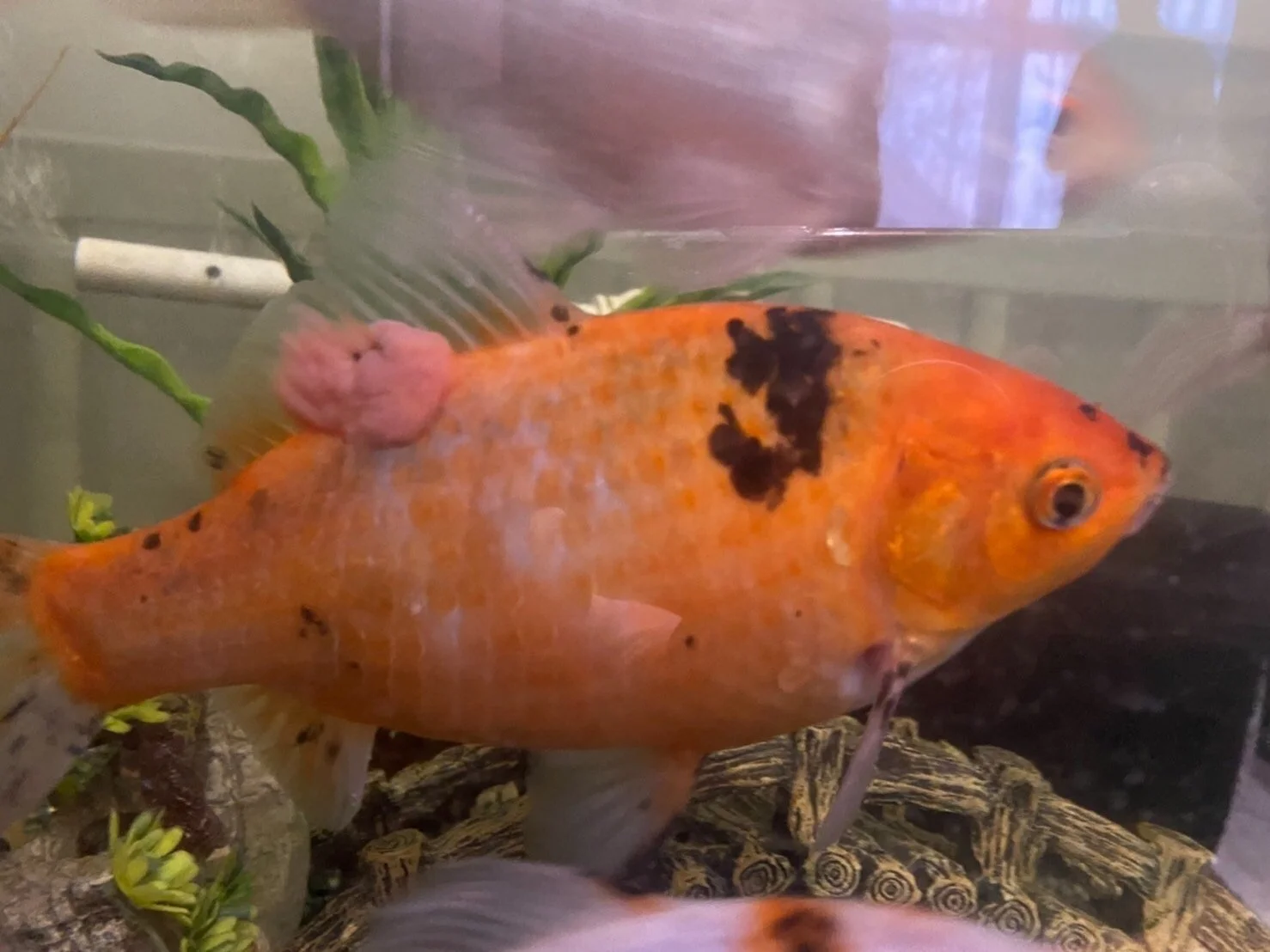
If a mass is present but not affecting mobility or ability to eat, then close monitoring is a fair option.
Causes
-
Masses in fish are either inflammatory, infectious or neoplastic (tumorous) in origin.
Looking at some of the infectious aetiologies of cutaneous (skin) masses in fish, Carp Pox caused by Cyprinid Herpes Virus 1 (CHV1) commonly found on koi and other Cyprinids, produces some of the most recognisable lesions in the hobby. The lesions are typically white or grey in colour, with a smooth texture, closely resembling drops of melted candle wax.
The lesions appear during the colder months of the year and usually regress during the warmer spring and summer months when the immune system is optimal. The virus itself rarely causes any major health issues and is widely considered more of an ‘aesthetic disease’.
Although not quite as recognisable as Carp Pox, Lymphocystis, caused by the iridovirus, Lymphocystivirus, is another viral aetiology that causes the appearance of masses on fish. Lymphocystis can be seen in both freshwater and marine species of fish. Lesions typically present as wart like processes that can appear anywhere on the body but tend to appear on the fins or operculum of fish.
For both Carp pox and Lymphocystis there are no recognised treatments that exist. As with many viruses, stress precipitates disease. So much so that Lymphocystis lesions will often regress quickly when stressors are removed and optimal water quality is provided.
Anecdotal successes of treating lesions using topical anti-virals is reported but results are unsubstantiated in scientific literature. As with any virus and other infectious agents, isolation of effected fish is recommended in order to prevent spread of the disease.
-
A lot of the masses identified on fish are neoplastic (tumorous) in origin. Fortunately, the vast majority of masses found externally are benign cutaneous masses, though few are definitively diagnosed via histopathology. Benign tumours are considered less aggressive as they are typically slower growing and less invasive to the surrounding tissues and have little or no metastatic potential (the ability to spread to tissues distant to the original tumour site). Benign tumours are often given the suffix, -oma in neoplastic nomenclature. For example, a lipoma is a benign tumour of lipocytes (fat cells).
Unfortunately, this is not the case for coelomic (internal) masses in fish. Coelomic masses tend to be malignant or cancerous in nature with aggressive spread and effect on local organs. The most common form of coelomic tumour encountered in pet fish medicine is gonadal carcinomas, most commonly seen in female koi and goldfish. Gonadal tumours are often extensive and invasive in their nature, affecting adjacent organs such as the kidney, swim bladder and digestive tract. Clinical symptoms often include coelomic swelling, dropsy, stretching of the skin and spinal curvature in severe cases. Where local organs are affected, buoyancy disturbances and obstruction of the digestive tract can also be seen.
Treatment Options
If identified as a tumour the options are quite limited. Unlike in other animals such as cats and dogs, no chemotherapeutic agents or protocols are recognised. Instead, the question comes down to whether or not a tumour can be removed surgically.
When assessing whether an external mass is suitable for surgery, a veterinary surgeon will look at the size, shape and location of the mass, as well as the base of attachment to the fish’s body. Benign tumours are usually well demarcated (defined), with a small base of attachment. These qualities make surgical treatment of these types of masses viable.
Aggressive tumours tend to have wider, more infiltrative bases which are harder to remove surgically.
For coelomic masses, diagnostic imaging will be required to confirm the diagnosis. It will also be used to assess the location of the mass and involvement with neighbouring organs. Unfortunately, very few coelomic masses will be taken to surgery due to the complexity and invasive nature of the tumours.
When to act
If an external mass is reducing the quality of life of the fish by reducing its ability to swim or eat then action needs to be taken quickly. If a mass is present but not affecting mobility or ability to eat, then a better quality of life exists and close monitoring is a fair option. During the monitoring phase, should the mass get bigger or change in shape, re-evaluation for surgery or treatment can be considered.
If a mass is fast growing it is often better to act sooner rather than later before the mass has the opportunity to grow wider and deeper into the surrounding tissues as some tumours will become harder to remove.
If your fish has a mass you’d like investigated, London Aquatic Veterinary Services can help diagnose and give guidance on the best treatment options available. For guidance on what to expect and prepare for ahead of aquatic surgery please see our page on surgical procedures.