
In some clinical scenarios London Aquatic Veterinary Services may advise you to feed your fish medicated food. This is usually always feed medicated with antibiotics to treat bacterial infections in fish. Giving fish oral (by mouth) antibiotics is a very common method used in fish medicine and is often preferred to other methods of medicating fish. Other routes for medicating fish include in water treatments such as baths and prolonged immersions and parenteral applications such as intra-muscular or intra-peritoneal injections.
London Aquatic Veterinary Services will guide you on what application is most appropriate for your fish and the type of disease present during a consultation. Several factors will be assessed which will include the severity of disease, the number of fish effected and most importantly, the appetite of your fish. For oral antibiotics to work effectively a fish needs to be eating consistently and adequately to benefit from the medicated feed. If a fish isn’t eating well then medicated feed will not be a suitable treatment option. In these cases, injections will be opted for instead.
A major benefit to using oral antibiotics, is the ability to treat large groups of fish quickly and efficiently. Imagine a scenario where a group of 20 koi need injecting every other day for five rounds for an ulcer outbreak. In most private, household settings, injecting 20 fish every day isn’t going to be logistically possible due to time and man power constraints.
Consider the fact that all these fish likely need sedating before the injection is given. You have also got to catch these fish and then separate out the injected fish from the non injected fish, as well as weighing the fish and drawing up the required medication and finally giving the injections… it’s absolutely possible but it is a lot to coordinate and will take up a lot of time! Instead, oral antibiotics offer a great alternative approach in this scenario. Providing all fish are eating, then oral antibiotics are a perfect way to get all 20 fish medicated and treated.
If all but a few fish are eating, a mix or oral and parenteral medication may be advised.
By feeding oral antibiotics to a group of fish, all fish eating the feed will receive a dose of medication. This is useful for catching fish that have subclinical disease (hidden disease without external symptoms) or fish with mild symptoms that perhaps hadn’t been spotted. Ulcers on the pectoral muscles and fin rot of the anal and pelvic fins can easily be missed.
Another benefit to oral antibiotics over parenteral antibiotic injections is the fact that no physical handling of the fish is required for oral dosing. Repetitive handling for injections is very stressful for a fish and with stress comes a reduction in immunity. Oral dosing eliminates the need for stressful handling interactions and allows the immune system to run smoothly. This is very important for sick fish as we want to promote and enhance the immune system as much as possible during treatment. For this reason, if the fish are eating, oral antibiotics will always be preferred over parenteral antibiotics.
This is not to say parenteral injections are bad and should never be used. London Aquatic Veterinary Services prescribes parenteral injections just as commonly as oral antibiotics and when used appropriately, they work wonders. Parenteral injections are particularly useful during severe states of disease when you want to get a medication into a fish fast or for situations where fish aren’t eating reliably.
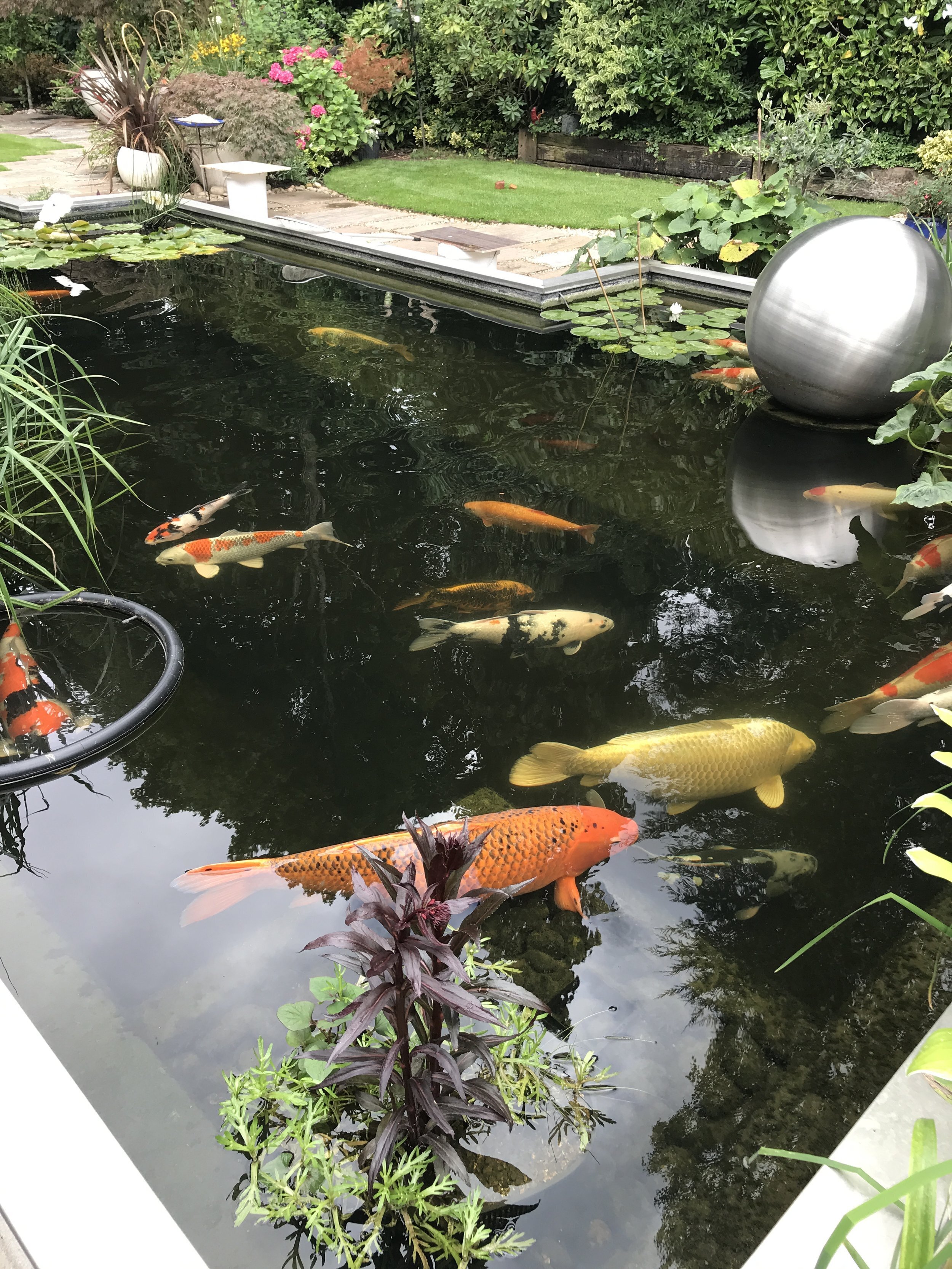
If a fish isn’t eating well then medicated feed will not be a suitable treatment option.
Considerations
All fish will eat different amounts of food so the amount of antibiotic consumed will vary within the group. To ensure all fish get a good helping of medicated food, feed multiple times throughout the day and feed enough that all fish get a chance to pick at the food. Look out for the smaller fish in your pond who often have to wait or make room for the bigger fish to eat. Spreading out the feed across the pond surface can improve the chances of smaller fish feeding successfully.
If you have sturgeon in the pond, feed them later in the day at a reduced ration to prevent koi from filling up on non-medicated food!
We also want to aim to feed a little bit less than the average daily ration in order to keep the fish hungry and coming back for food every day reliably.
Dosing
London Aquatic Veterinary Services will calculate a daily dose rate for your fish. To do this, you will be asked how many grams of food you feed per day. Measuring scales will be available to use on the day of the consult to help you find this value out. From this daily ration of food in grams, London Aquatic Veterinary Services will calculate how much antibiotic to mix with the food and feed daily.
For small amounts of food (like those fed to goldfish or smaller collections of fish) the amount of antibiotic used daily will be very small. In these cases London Aquatic Veterinary Services will calculate a 7-14 day dose for you.
Koi and goldfish pellets work best when medicating fish. Dried food and flake foods should be avoided.
To hide the taste of the bitter antibiotics (and to bind the antibiotic to the powder) you will need to use a binding agent such as cod liver oil or runny honey. Cod liver oil tends to work the best and doesn’t cause clumping like runny honey can. To avoid clumping seen with runny honey, premix the honey with some warm water to thin it out before mixing with the food. If you use too much and clumping is seen, no major issue just reduce the amount you use the following day.
Preparation of Antibiotic and Food Mix
Equipment and ingredients:
Ziplock bag, or Tupperware box
Antibiotic Powder or liquid
Pelleted fish food
Cod liver oil or runny honey
Instructions for powdered antibiotic:
Mix daily food ration (X grams) with antibiotic powder by shaking together in a Ziplock bag or Tupperware box until evenly distributed to create a ‘dry mix’ of ingredients.
Next, add a small amount of cod liver oil or runny honey to the bag/box and shake well again to coat the pellets to create a ‘wet mix’.
Use enough oil/honey that all pellets are very slightly greasy. Try to avoid the pellets from clumping together.
Feed out from the wet mix of food throughout the day.
Repeat steps 1 – 4 daily for the duration of the antibiotic course.
If you want to make up several days ration in one go, make up no more than 2 days in advance and ensure the wet mix is stored in the fridge in between use.
ALTERNATIVE Instructions for powdered antibiotic:
Premix the course length of food (daily ration x course length 7/10/14 days) with the antibiotic powder to create the dry mix.
Shake well in Ziplock bag or Tupperware box until evenly distributed.
Set the dry mix aside.
On the day of dosing, shake the dry mix a few times before taking out the daily ration of food from the premade dry mix.
To this daily ration of dry mix add a small amount of oil/honey and shake well to evenly coat the pellets to create the wet mix.
Feed the fish from this wet mix throughout the day.
Repeat steps 4-6 every day for the duration of the course.
If you want to make up several days ration in one go, make up no more than 2 days in advance and ensure the wet mix is stored in the fridge in between use.
Instructions for liquid antibiotic:
Mix the daily antibiotic dose with a small amount of cod liver oil. 2-4ml is usually a good place to start.
Next, mix the oil and antibiotic combination into the daily ration of food to create the wet mix of food. Use a Ziplock bag or Tupperware box to shake the two together until evenly mixed. If there is too much oil to food, reduce the amount of oil used the following day. You can soak up any excess medicated oil by adding more food on this day.
Feed out from the wet mix of food throughout the day.
Start the process again fresh the following day, repeating steps 1 -3 for the duration of the course.
If you want to make up several days ration in one go, make up no more than 2 days in advance. Store the wet mix in the fridge in between use.
Please note: making fresh medicated feed daily is recommended.