Bacterial infections in Koi make up a large majority of the case load at London Aquatic Veterinary Services, with ulcers and fin rot being the most common symptoms in need of treatment.
Ulcers
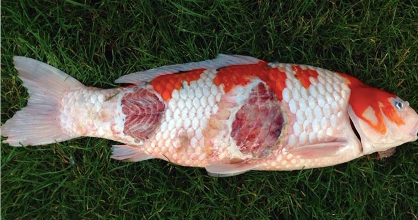
Ulcers are caused by bacteria eating away at cutaneous tissue
An ulcer can be defined as a breach in continuation of the skin caused by sloughing of necrotic (dead) and infected tissue. Ulcers can vary in severity from superficial depressions and blemishes in the skin surface to much deeper lesions that can expose muscle layers and ultimately even breach the body cavity.
Ulcers typically represent an external bacterial infection but in severe cases the infection can spread systemically (internally, through the blood supply) inducing signs of septicaemia. These symptoms can include exophthalmos (bulging eyes) engorgement of blood vessels in the fins and body and in the end stages ‘dropsy’. Dropsy is a result of renal (kidney) failure and is due to fluid build-up in the body cavity and tissues under the scales causing the dreaded pine cone appearance. For this reason, once dropsy is present, the prognosis is poor.
Ulcers themselves are caused by bacteria eating away at cutaneous tissue but there are many reasons why a bacterial infections might be present in the first place. It is important to appreciate the fact that the majority of bacteria causing ulcers in fish are considered ‘opportunistic or secondary pathogens’. The bacteria responsible are often present in low numbers in healthy ponds and on the skin of fish and only cause disease when something else has gone wrong which allows them to multiply out of control. Some of the common causes for this are;
Poor water quality (high waste products, low KH/low pH)
High bacterial load in the water, often secondary to poor pond/filtration design
High parasitic loads
Viral infections
Almost all of the above, open the door to bacterial infections by reducing the immune system of the fish.
What to expect from a consultation?
Due to the complex nature and susceptibility of koi to bacterial infections, it is extremely unlikely that an established ulcer case will be fixed in one consultation. Depending on the severity and complexity of the case, it can take anywhere from 3 – 10 visits to complete and there is certainly no ‘quick fix’.
Bacterial cases are further complicated by that fact that help is often requested late into the disease progression. A lot of the time multiple pond and fish medications will have already been used. Fish are often weak from repetitive chemical treatments and disease.
All consultations will start with the basics; thorough history taking, full panel water quality analysis, parasite screening and visual inspection of the pond and filtration systems.
Fish will be examined under a light sedation. Those that require topical treatments will be treated accordingly.
Depending on what is found in the initial stages of the consultation it is very likely diagnostic samples of the ulcers or pond water will be taken for analysis.
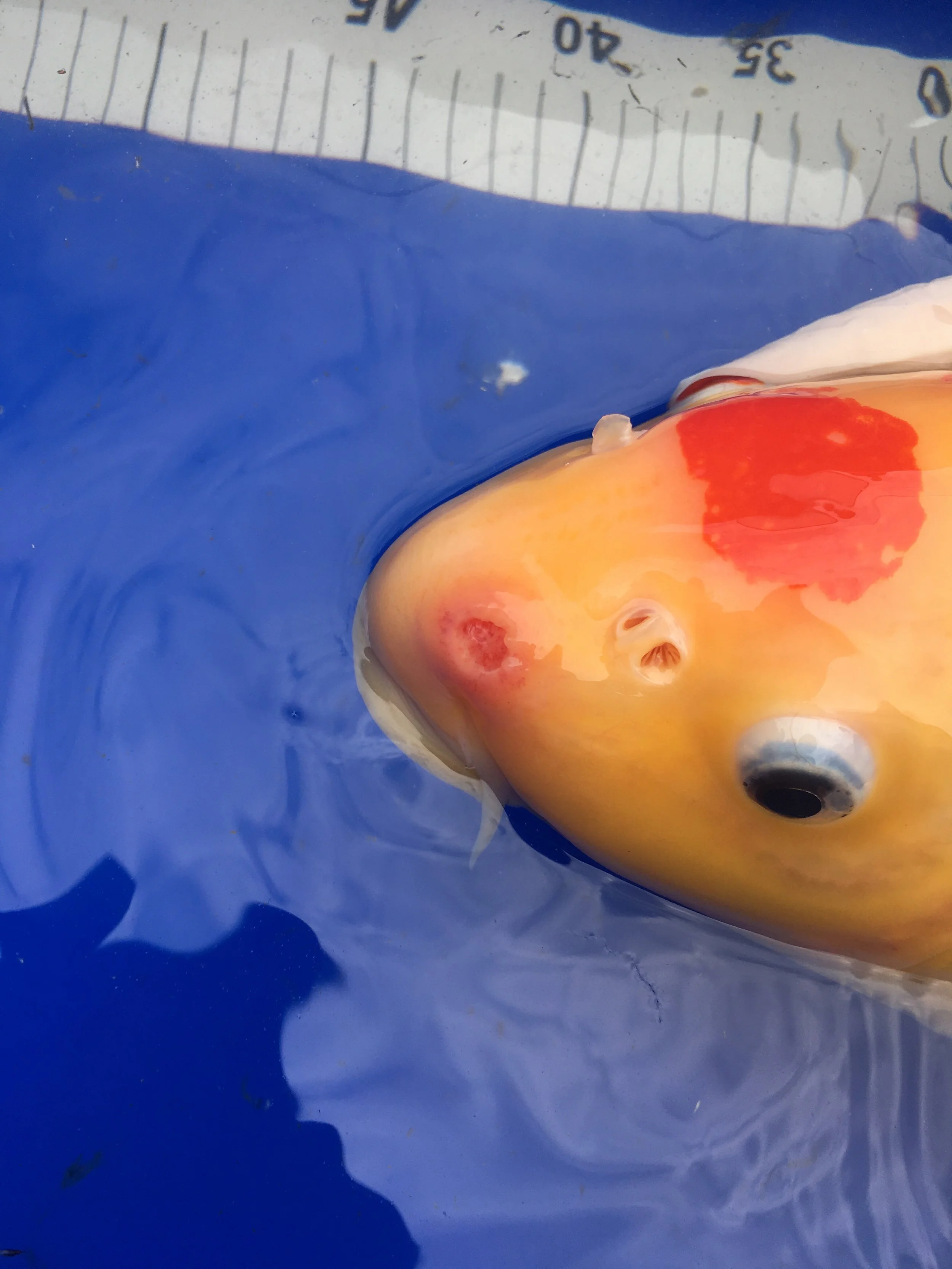
Fish will be examined under a light sedation.
Diagnostic Testing
Culture & Sensitivity: C&S testing is a laboratory run process that identifies what micro-organisms are present at an ulcer site by culturing them on a specialised growth plate. Once grown the micro-organisms are subject to antibiotic sensitivity testing to identify the best choice of antibiotic. For the best and most accurate results, swabs can be taken from the kidney post mortem. This will highlight bacteria present in the blood and therefore the most pathogenic bacteria involved.
Microbial Water Analysis: MWA is a test performed on a sample of pond water that identifies and quantifies how much bacteria, fungi or yeast is present within the water of your pond. This test is particularly useful for cases with high morbidity (lots of fish in the same pond affected). High bacterial loads in the water form an infection pressure, which often causes reinfection and propagation of disease.
Virology Polymerase Chain Reaction (PCR): PCR will often be used for cases with suspected viral involvement (often those with gill pathology and high mortality rates). Small samples of gill tissue will be taken for PCR analysis. Viral agents tested; Koi Herpes Virus “KHV” and Carp Sleeping Disease, “CEV”.
Diagnostic testing is essential to working up a case successfully. Targeted treatment alongside excellent water quality and parasite control is the key to case success.